
Understanding Report Status and DTI Outcomes
AcuCheck provides clear status indicators and debt-to-income (DTI) outcomes to help lenders track report progress and interpret affordability results with confidence. Together, report status and DTI outcomes create a complete picture of where a customer stands in the assessment lifecycle and how their financial capacity aligns with organizational thresholds.
Report Status Overview
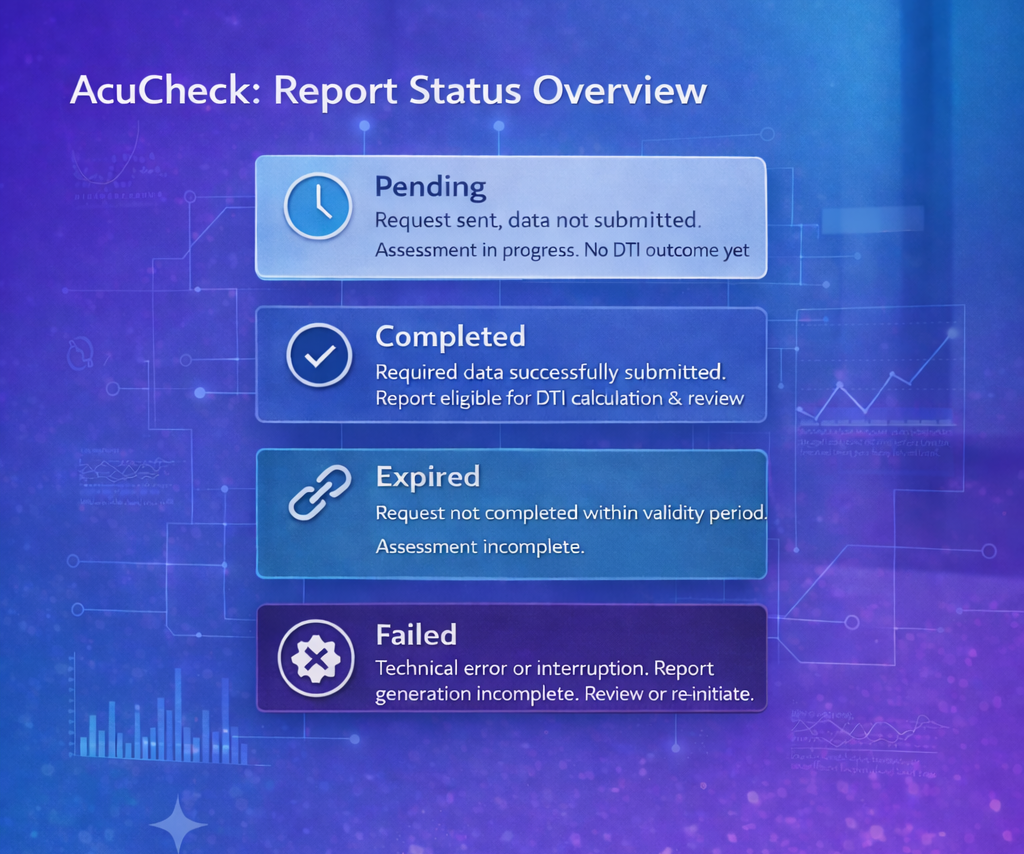
Pending
A report is marked as Pending when a request has been sent to the customer but the required financial information has not yet been fully submitted.
Pending status indicates that the assessment is in progress and that no DTI calculation or outcome is available yet. Visibility into pending requests helps lenders monitor follow-ups and manage timelines proactively.
Completed
A report reaches Completed status once the customer has successfully submitted all required financial information and the report has been generated.
Completed reports are eligible for DTI calculation and outcome evaluation. At this stage, users can review consolidated financial data, calculated DTI values, and related results without further customer action.
Expired
A report is marked as Expired when the customer does not complete the request within the configured validity period.
Expired status indicates that the assessment could not be completed as requested. Depending on configuration settings, expired requests may be eligible for resending, allowing the workflow to resume without recreating the customer record
Failed
A report is marked as Failed when the report generation process cannot be completed due to a system error, data processing issue, or an interruption during the submission or consolidation stage.
Failed status indicates that the request did not successfully progress to report generation. In this state, no DTI calculation or outcome is produced, and the request may require review or re-initiation based on the nature of the failure.
Understanding DTI Outcomes
DTI outcomes represent the result of evaluating a customer’s debt-to-income ratio against configured organizational thresholds. These outcomes provide context for affordability assessment and help standardize interpretation across users and teams.
DTI outcomes do not replace lending decisions; instead, they provide structured input to support those decisions.
DTI Within Configured Limits
When a calculated DTI falls within the configured limits, it indicates that the customer’s financial obligations are proportionate to their reported income based on current policy settings.
This outcome supports progression in the lending workflow and signals that affordability criteria have been met under the defined parameters.
DTI Exceeding Configured Limits
When a calculated DTI exceeds configured thresholds, it indicates higher relative financial obligation compared to income.
This outcome highlights potential affordability concerns and signals the need for further review, additional verification, or alternative lending considerations, depending on organizational policy.
Relationship Between Status and Outcomes
DTI outcomes are available only for reports in Completed status. Pending and expired reports do not produce DTI outcomes because the required financial data is incomplete or unavailable.
This clear separation ensures that outcomes are based only on finalized, consolidated report data.
Traceability and Review
All report statuses and DTI outcomes remain associated with the customer record and request history. This traceability supports internal review, consistency checks, and operational transparency across affordability assessments.
By combining clear report statuses with standardized DTI outcomes, AcuCheck helps lenders understand both where a customer is in the assessment process and what their financial position indicates. This clarity supports faster interpretation, consistent evaluation, and informed decision-making.